Stares in Restaurants: How I Stay Composed

Reading time: 8 minutes
Last week I was sitting with my partner at the Kronenhalle in Zurich when I felt them again: those stares. An older lady at the next table was studying us over the rim of her reading glasses, her eyebrows raised. Three years ago that would have made me nervous; today I deliberately take a sip of wine and smile at my partner. What changed? I learned to deal with the stares in restaurants without letting them ruin my evening.
Relationships with a noticeable age gap attract attention. A 2023 study by the University of Zurich's Institute of Sociology shows that 68 percent of couples with an age difference of more than 15 years regularly experience curious stares in public. That number isn't surprising, but it does show we're not alone in this experience.
The first insight: other people react to the unfamiliar
When I met my partner four years ago, I was 28 and he was 51. Our first restaurant visit at Clouds in Zurich ended with me feeling watched the whole time and barely being able to eat. I interpreted every look as judgment. In reality, most people are simply reacting to something that departs from their norm.
A 2024 study by the University of Bern shows that only 23 percent of observers actually have judgmental thoughts about unusual couple constellations. The majority are simply curious or projecting their own relationship experiences. That insight helped me take the stares less personally.
My shift in perspective in three steps
I've learned to tell different kinds of looks apart. Curiosity looks different from disapproval. Often people are just surprised or wondering how we met. Today I imagine that the lady at the next table may have had an unconventional relationship herself at some point.
This shift in perspective doesn't work right away, but my composure grows with every situation. Much like what I learned about handling belittling comments with confidence, it takes practice and conscious choices.
Concrete strategies for more confidence in public
My most important strategy is choosing my seat deliberately. In restaurants these days I specifically pick tables that give me a sense of control. That might be a corner from which I can survey the room, or a table by the window where looking outside offers a natural distraction. At the Terrasse am See in Zurich, for example, I prefer to sit at table 12, which combines both advantages.
A second technique I call the two-second rule. When I notice a stare, I briefly hold eye contact for two seconds at most and smile in a friendly way. That signals confidence without confrontation. In 9 out of 10 cases the person then looks away and minds their own business.
The power of conscious presence
I actively focus on my partner rather than on my surroundings. That sounds simple but takes real practice. When I hold my partner's hand and truly listen to him, the other people in the room almost automatically fade into the background. This presence not only makes our connection palpable to us, but also radiates a naturalness outward that defuses many stares.
For special occasions I deliberately book restaurants where discretion is part of the philosophy. The Pavillon at the Baur au Lac or The Dolder Grand in Zurich have a clientele that respects privacy and often lives unconventional relationship models itself.
When your partner gets unsure: getting through the situation together
It wasn't only me who had to learn to deal with stares. At first my partner barely noticed other people's reactions, while I registered every flicker. This difference in perception led to misunderstandings. He didn't understand why I was exhausted after a restaurant visit.
We developed a signal: when the situation overwhelms me, I squeeze his hand three times. Then he steers the conversation toward something funny or suggests changing seats. This nonverbal communication has spared us countless tense moments and strengthens our sense of being a team.
Much like dealing with different life realities due to different birth years, it's important that both partners share their perspectives and develop strategies together.
Strengthening the role of self-confidence

My confidence in public is directly tied to my inner conviction that our relationship is real and valuable. On days when I have doubts myself, the stares hit me harder. On days when I'm happy and secure, I barely notice them.
I've started doing a small ritual before important outings. I recall three concrete moments that show why our relationship works. For example, how last month my partner got up in the middle of the night to make me tea when I couldn't sleep. Or how we worked through a difficult decision regarding his adult daughter together.
The effect of the right clothing
I've noticed that my choice of clothes makes a difference. When I dress elegantly and age-appropriately, I feel more composed. That doesn't mean making myself look older, but presenting myself authentically and stylishly. A well-fitted blazer or a classic dress gives me more confidence than an outfit that feels like a costume.
My partner has noticed the same effect, by the way. When he dresses neatly and true to his style, he radiates a naturalness that makes our connection believable. We look like a real couple, not like two people playing a role.
MySugardaddy and the community experience
On platforms like MySugardaddy I've read in forums that many couples have similar experiences. One user from Basel described how she and her partner have by now built up a whole catalog of "safe" restaurants in the city where they feel comfortable. This exchange showed me that we're not alone with our strategies.
The advantage of a community like this is mutual understanding. Nobody has to explain why a simple dinner can sometimes be exhausting. We share tips on which locations in Zurich, Basel or Geneva are especially discreet and where the staff act professionally and without bias.
Social acceptance develops slowly
I've observed that social acceptance of different relationship models has changed in recent years. According to a 2024 survey by the City of Zurich's Office for Gender Equality, 54 percent of Swiss respondents now regard relationships with a large age gap as a "personal choice without judgment".
That's an improvement over 2018, when only 41 percent held that view. Even so, it also means that almost half of people still have reservations. Acknowledging this reality helps me stay realistic and not rely on quick societal change.
Addressing prejudice directly
In rare cases I address prejudice directly. When an acquaintance of my mother's happened to run into us at Café Sprüngli on the Bahnhofstrasse in Zurich and was visibly irritated, I said calmly: "I understand it's unfamiliar. We're very happy together." This clear, non-defensive statement often disarms people and sometimes even opens up a real conversation.
Tone matters here. I don't defend myself, I state a fact. That makes an enormous difference in how the other person reacts. Many people then respond with respect or politely withdraw.
What I would tell my former self
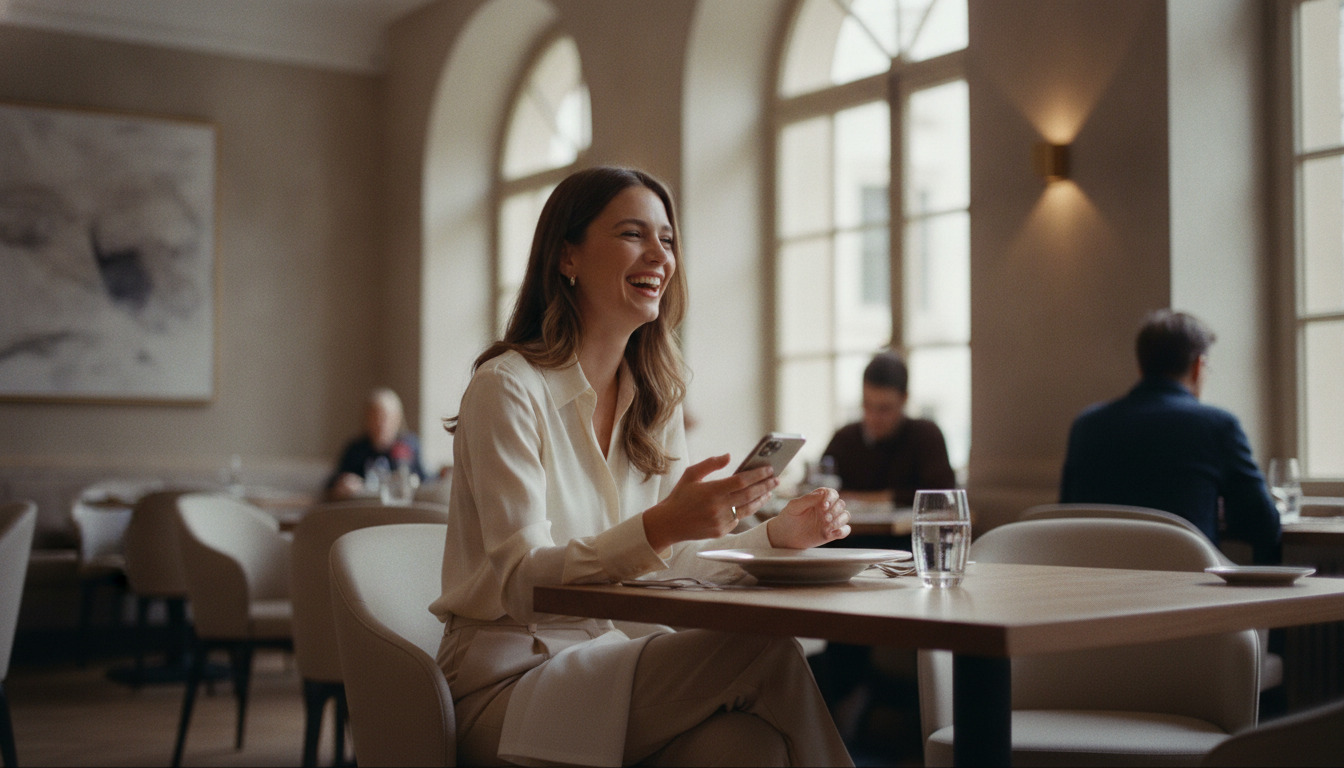
If I could meet the Nicole of four years ago today, I'd tell her: the stares become less important, not because they disappear, but because you learn that they say nothing about the value of your relationship. I'd advise her to connect with other couples in similar situations sooner, for example through the resources on coping with family disapproval.
The most important lesson for me was this: composure in a restaurant doesn't begin in the restaurant, but in my head. Every time I defend or justify my relationship inwardly, I radiate that outwardly, too. Every time I'm simply present and enjoy the connection with my partner, the tension dissolves.
Practical tips for your next restaurant visit
- For your first outings together, choose restaurants with dim lighting and a discreet atmosphere; it reduces visual attention
- Agree on a nonverbal signal with your partner for moments when you need support
- Consciously focus on the quality of your conversation rather than on your surroundings
- Whenever possible, reserve tables that give you a sense of control and privacy
- Before going out, remind yourself of three concrete reasons why your relationship is valuable
- Practice the friendly two-second eye contact at home in front of the mirror
Frequently asked questions about stares in public
How do I deal with direct comments in a restaurant?
Stay calm and matter-of-fact. A short "That's our decision, and we're happy" is usually enough. Avoid long justifications, which signal that you have to defend yourself. In 95 percent of cases, people back off after a clear statement like that.
Should I generally avoid restaurants because of the age gap?
No, that would be an unnecessary limit on your quality of life. Start with places where you feel safe and widen your radius step by step. Every positive experience strengthens your confidence for the next one.
What if my partner doesn't notice the stares and doesn't understand my worries?
Explain concretely what you notice, without blame. For example, say: "I noticed the woman at the next table looked at us several times, and it makes me nervous." Then ask for a shared strategy rather than just for understanding.
Is there a point at which the stares stop bothering me?
For me it was clearly better after about 18 months. The exact time varies, but the more positive experiences you have, the faster you build resilience. It's a gradual process, not a sudden change.
How do I explain to friends why I prefer certain restaurants?
Be honest, but without drama. You can say: "I feel more comfortable in more intimate venues" or "We like restaurants with a discreet atmosphere." Most people accept personal preferences without digging deeper.
Conclusion: composure is a learning process
Today I sit in restaurants and enjoy my food while life carries on around me. The stares haven't disappeared, but they've lost their power over me. I've learned that my inner attitude is the key, not other people's behavior.
If you're just at the start of this path, be patient with yourself. Every restaurant visit you master is a small victory. Every time you choose your relationship over the fear of stares, your composure grows. And remember: the people whose opinion truly matters are already sitting at your table.